Preface
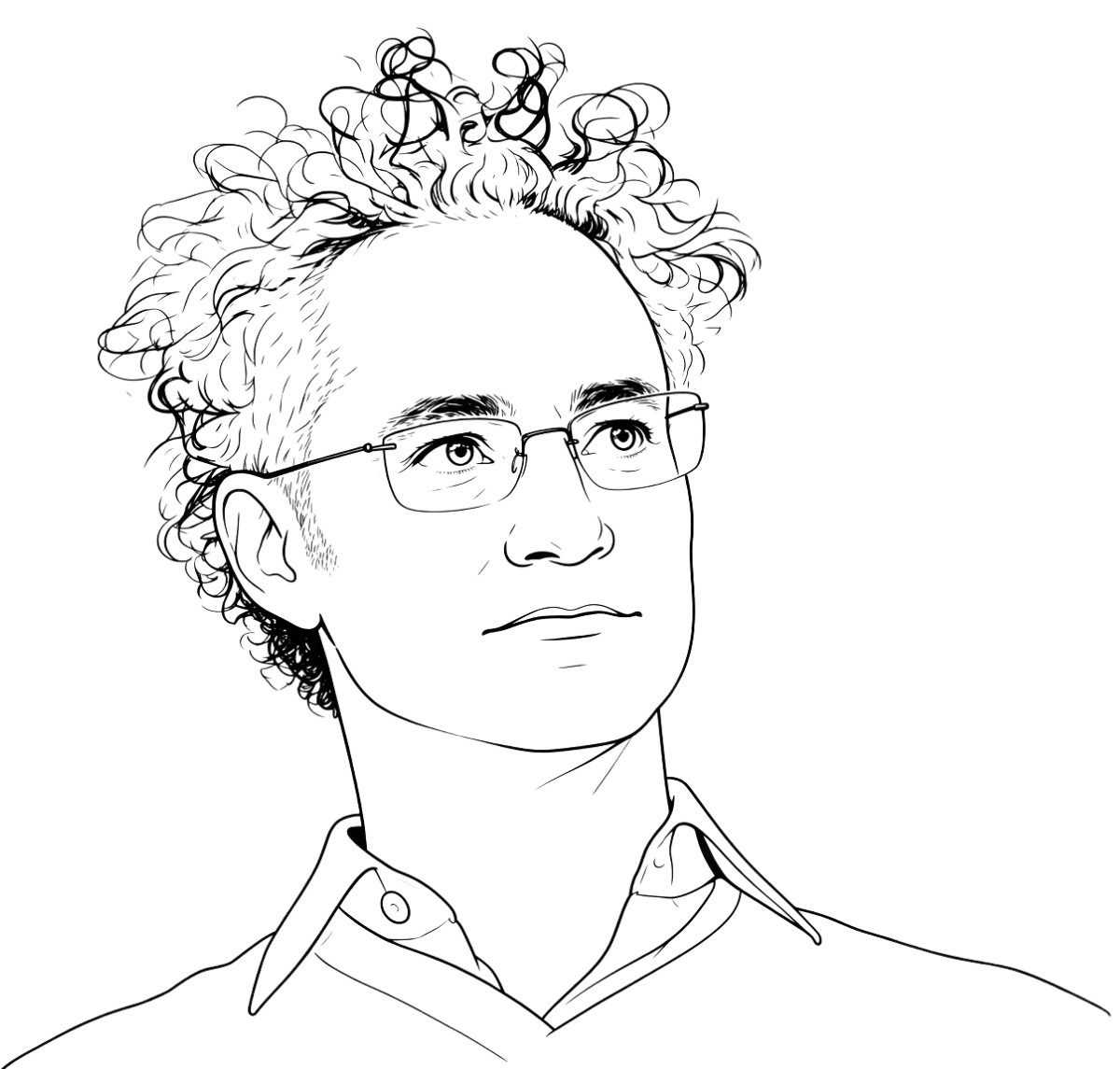
Alex Karp would have preferred to be a painter. He says business is not the most important métier; it just happens to be the one he's really good at. His mother, a professional artist, spent a lifetime tapping into something very deep that is rarely understood about the period of time it's made in — and got almost nothing for it. His father, a pediatrician for underserved communities, poured his intellect into service. His extended family looked like the physics department at Princeton meets an art colony: extremely high-IQ, deeply cultured, not particularly rich. They stuck to their guns about how they saw the world, and that's why they weren't rich.
The Family
Alex KarpJoe Lonsdale: American Optimist
Karp was born in New York and grew up in the suburbs of Philadelphia, where he went to the local magnet school. The intellectual rigor at home was so relentless he says he wanted to vomit all the time. Every dinner consisted of his mother's encyclopedic knowledge of obscure architecture, arguments about Reagan, and conversations about ethics and human rights and mathematics. Every weekend: museums and cultural events. After he left home, he couldn't walk into a museum for a decade.
He soaked up the fundamental structures of Western thought and art, went to Haverford, then Stanford Law — where he spent most of his time arguing with Peter Thiel and reading books.
He didn't want to do a US doctorate. That would mean a master's and three years of what he called "regurgitation" — he'd already done a three-year bid at Stanford, and what he actually wanted was to write about Germanic post-war thought. His father's family was from a German-speaking region for about a thousand years — his grandmother's first language was German — so he arrived in Frankfurt with what he calls a "pre-German vibe". He read Plessner, Heidegger, Husserl. Published on Neo-Kantian philosophy and Freud, on discrimination and civil liberties and antisemitism — on anything that anyone would read.
From the outside things looked different. Mixed-race in an era that didn't know what to do with that. Dyslexic — the full-on dosage, not the milder version his father and uncle had — in a family where success meant reading and writing at the highest level. An artist's kid in a system built for something else.
Alex KarpJoe Lonsdale: American Optimist
None of this turned him against the system. The opposite. Karp decided that Western liberal democracy — rule of law, free expression, property rights, meritocracy — was the only thing keeping people like him from catastrophe. Not because the system was kind to outsiders. Because it was the least hostile.
Alex KarpJoe Lonsdale: American Optimist
And if those protections ever broke down, he knew where he'd end up:
I always thought if fascism comes, I will be the first or second person on the wall.
Alex KarpJoe Lonsdale: American Optimist
Dyslexia
He hid his dyslexia for decades. Through law school, through a PhD in philosophy, through building a company now worth hundreds of billions. Then, somewhere around 2017 or 2019, he told a friend during dinner. The friend's response? Could you pass the salt?
Now he talks about it constantly, and the way he explains it has changed. Early on, the advantage was discipline — he never does things he's bad at because the gap between his strengths and weaknesses is too obvious to ignore. Then came the processing claim: he picks up on sparse data way before anyone else, and much quicker. His high-IQ family needed more information to reach a conclusion. He needed almost none.
By 2025, he was connecting it to something bigger.
Alex KarpThe 92nd Street Y, New York
The playbook — standardized thinking, best practices, all of it — is now something a machine does better than any human. What's left is the weird, particular, culturally specific stuff. The thinking that doesn't fit taxonomies. The kind dyslexics have been forced into their whole lives.
Alex KarpThe 92nd Street Y, New York
He runs Palantir, he says, like managing dyslexics. The company hires very opinionated, difficult, free-thinking fanatics — people exceptional at one thing even if they're failing at something else. Not well-rounded. Spiky. The kind of person who makes everyone uncomfortable and then builds something nobody else could have imagined.
Karp supplies his own caveat: "Without Peter [Thiel], I would not have been hired." Thiel believed in him before the market did. Now, Karp says, anybody would hire him — and for maybe the wrong reasons. The wrong reasons being the track record, the money — not the qualities that actually made him valuable. The system eventually corrects. American tech will completely recalibrate once results prove the initial rejection was wrong — what was unlikable becomes the feature. But it needs someone willing to make the first bet before the results exist. Meritocracy worked for him. It just couldn't see him at the beginning.
Aufheben
The questions that drove Karp to Frankfurt — what does it mean to know something? what is the foundation of Western society? can we participate as citizens, and how? — were not idle. But he left when he realized he couldn't match his mentor — the dyslexia meant he couldn't write a world-class book every three months the way Luhmann could — and that he had a rare ability to build. When Peter Thiel called about co-founding a company, Karp said yes without asking about compensation or benefits.
The philosophy came with him. It became the engine. In 2026, he named it:
Alex KarpPalantir
Here's how it works. Data protection and anti-terror look like opposites — until you reframe both as augmenting the value of life. What is life? It's being alive and having rights. The person who only cares about killing terrorists wants to live in a world that's not worth defending. The person who only cares about civil liberties ends up helping the people who actually don't care about civil liberties get in charge. Push either pole to the extreme and it destroys itself. The Aufheben is building a product that does both.
That product works like this: when a government collects your data, Palantir's platform tags it by source so it can't be migrated into a different case. If it gets used against you, your defense attorneys will see where it came from. And the same transparency that finds terrorists lets you see what the government is doing with your data — not through algorithms nobody understands, but directly, so that Congress or attorneys can determine whether investigations are legitimate or based on improper criteria. Restrict and log.
The principle, as Karp put it in 2009:
Alex KarpCharlie Rose
On the battlefield, the same integration and security model powers troop positioning, targeting, and route planning. On the commercial side, it's the infrastructure that makes AI actually work in an enterprise — what Palantir calls ontology, the framework that maps a company's logic so an AI model can operate inside it without breaking anything.
None of these products started from what the market was already doing. They started from what Karp thought the market should be doing:
Alex KarpDavid Carbutt
So they didn't just build software to stop terrorism. They built software to augment civil liberties while stopping terrorism — five or six layers deeper than the obvious product, enduring years of investors asking where the money was, with Karp telling them to wait.
He's running the same play now with what he calls sovereign AI — the idea that companies and nations should own their entire stack, from GPU through ontology to model training, rather than transferring their data and competitive advantage to frontier labs. It's basically the same place Palantir was in with Gotham (their government product), where instead of protecting intelligence data from migrating between cases, it's protecting every American company's competitive advantage from being extracted by the labs they depend on.
The Aufheben again: you shouldn't have to choose between AI capability and control over your own business. The companies that make you choose are, in Karp's view, transferring your "alpha", your unique insights, to a third party — which would be basically immoral and illegal.
How do you prove a philosophical conviction was right? Not by arguing — by building. The "ought" can't be validated in advance. You have to construct the thing it demands, put it into the world, and see whether the world responds. If it works, people look at the result and assume the way you see the world is correct. If it doesn't, the philosophy was wrong.
Karp learned this as a broke graduate student in Germany, where a rural family told him what made them stop being Nazis. It wasn't argument or ideology. It was that American ways of thinking made them healthier and wealthier and happier. They adopted the worldview that delivered.
Subscribe for the next portrait
People, from their own words.
The West Must Win
Karp thinks the West is superior. Not in an abstract way. On the specific metrics its critics use to attack it:
Alex KarpPalantir
But the superiority doesn't sustain itself. It sits on top of force. When pressed with Huntington's thesis — that the West rose through "superiority in applying organized violence," not ideas — Karp didn't flinch:
Alex KarpThe New York Times
China is America's primary and most important adversary. Not enemy — adversary. A competitor to be outpaced, not a country to be conquered. AI on the battlefield will decide the values, the norms, the laws, and the spirit of the laws imposed across the globe. If America loses its edge, adversaries set up a different world order. They play by the current rules only because the current rules are backed by American power.
Ukraine showed what this looks like when it works. A country that "essentially started from nothing" held its own against a military spending $65 billion a year, using algorithmic warfare. Karp calls it arguably the most important AI event ever — algorithmic warfare plus heroic fighters changing the course of history. When Google wouldn't support the US military, Palantir stepped in to build Project Maven.
But military superiority alone doesn't sustain a system. The people living under it have to feel it's working for them.
Alex KarpWorld Governments Summit
"Working" means something specific: "I put in a dollar, I get more than a dollar out. That's working." The dollar isn't literal. It's the felt experience of return — you put in your effort, your taxes, your participation in the system, and you get back something worth more than what you gave. Safety, opportunity, the sense that tomorrow will be better than today.
What Changed
When asked about his political "shift" in December 2025, Karp cut the interviewer off:
I didn't shift my politics. The political parties have shifted their politics.
Alex KarpThe New York Times
He goes back to the Friday-night lectures of his childhood. Fifty years of hearing that conservatives were destroying the country through mass immigration that undermined the American worker. That was considered progressive. Now that same position is conservative. Karp thinks this is insane.
"Fake progressivism," in his telling, means embracing dysfunction, socialism that has never worked, and abandoning meritocracy. Real progressivism means the working class does better tomorrow than today and knows it. Asked in 2026 whether he still considers himself progressive:
Alex KarpMDMEETS - Essential Talks with Mathias Döpfner
He's been arguing with Peter Thiel for 30 years. Since Stanford Law. Karp on the left, Thiel on the right, neither has moved. That argument is how Karp predicted Trump's first win — he was talking to people who disagreed with him. His Democratic friends weren't.
Alex KarpThe Aspen Institute
The thing that bothers him on both sides is the same:
Alex KarpTBPN
He says he's been saying the same thing for 20 years — close the border, reject identity politics, build a strong military, be skeptical of the neocon project, bet on technology. What has changed is how loud he says it. In 2009, he was talking about data tagging and predicate-based searching — the technical plumbing of civil liberties. By 2025, he was calling progressive institutions "Stalinistic bullshit". But in that same conversation, he turned around and steelmanned the people he'd just insulted:
Alex KarpAll-In Podcast
Culture
Alex KarpSourcery with Molly O'Shea
He figured this out by living somewhere else. In Germany, he fought to hire the most qualified person. They told him nobody does that. In Europe, the community decides who belongs. In America, you decide — you set the rules of your own community.
America is Calvinist — building something important is good. Europe is Lutheran — success is suspicious, and moralizing about entrepreneurs is easier than asking why you don't have any. Instead of asking why their culture produced no major technology companies, Europe calls the people who built one techno-fascists. Peter Thiel — co-founder of Palantir, partially Germanic — gets atrocious treatment from the German press.
Alex KarpMDMEETS - Essential Talks with Mathias Döpfner
Karp has worked with thousands of organizations — clandestine, military, police, commercial — and he's never found one that works at a high level without a strong belief structure inside it. You need primordial-level talent willing to stick with something painful for five years, working next to someone brilliant who annoys the crap out of you every day. Money alone doesn't get people through that. You need belief. America produces more great companies because it's a "belief culture" — you define your own community, set your own rules. Sounds obvious. But it only really exists at scale in one country.
Alex KarpThe Free Press
If you're told that all nations are equal, why would you build something difficult and dangerous for any one of them? You wouldn't. And for twenty years, most of Silicon Valley didn't.
Every time critics said what Karp calls something ridiculously stupid about Palantir, the smartest people got curious. Investigated. Concluded the criticism was shallow. Decided Palantir was the only company they wanted to work at. France, where Palantir has its worst brand perception on Earth, produces its best employees — every time the Communist Party attacked, the sharpest French minds dug in and stayed:
Alex KarpPalantir
His theory of how this becomes lasting change is blunt:
Alex KarpThe Economic Club of Chicago
Clusterfuck
The concern Karp carries into conversations about Artificial Intelligence is older than Palantir, older than the PhD, older than the Aufheben. It's the Friday-night lectures of his childhood — cheap labor was going to destroy the American worker, and the people promoting it didn't care. Everything in his worldview rests on one premise: the system must actually work. The working class does better tomorrow than today and knows it. The outsider is protected only for as long as ordinary people feel the system is still working for them.
[AI] is definitely not a technology where everyone wins.
Alex KarpAmerican Compass
The tech industry speaks in jargon that masks either a longer AI development timeline or genuinely hard truths that are difficult for people to discuss. There is no class of people with less public support than tech leaders in this country. AI carries theological aspirations with no tethering to a major religion. And extreme wealth concentrating among a very small number of people gives everyone else a sense that this is not a fair, maybe potentially rigged game. He calls it a clusterfuck.
In past revolutions, the math was manageable — the person at the bottom saw their salary double while the person at the top became five times wealthier. AI creates different math. The people at the top get ten, a hundred times wealthier. And the wealth doesn't just concentrate — it concentrates among "very oddly shaped IQ specimens that you probably wouldn't wanna have over for dinner", in a country where the wealthy have already sorted themselves into separate schools, separate neighborhoods, separate lives — separate and not-equal, and everyone knows it.
Alex KarpThe Economic Club of Chicago
America tolerates extreme wealth because it is the most Calvinist culture in the world — the backdrop is that success is celebrated, not suspected. But if that slips, everybody who is succeeding or is perceived to be in a group that is disproportionately succeeding will end up on the firing wall.
Alex KarpMDMEETS - Essential Talks with Mathias Döpfner
The people know the candidates are destructive, but they're the only ones willing to say the system isn't working. And that's enough. He has a name for where this ends up: the horseshoe effect. Far left and far right converging on one verdict — the tech industry isn't paying my bills, so nationalize it.
Alex KarpAmerican Compass
Inside organizations, AI functions as penetration testing for value — it strips away middle management whose tasks a language model can do cheaper and exposes who's actually creating the value underneath. For vocational workers, that's good news. They're systematically underpaid. AI makes their contribution undeniable. For white-collar workers — the educated generalists, the knowledge class — it's a different story, and Karp is skeptical that a good answer exists:
Sean O'Brien, Alex KarpAmerican Compass
These are the people who'll fuel the unrest. Not because they're poor — because they were promised a world that no longer exists. Maybe half would accept a clear path forward rather than "vote for Mao". And the window for acting is itself a bet. Everything Karp says about blue-collar workers gaining leverage rests on AI still having some inability to interact with the physical world.
Alex Karpa16z
The tech elite, he says, reifies rights — they treat rights as permanent fixtures, baked into the structure of reality, rather than fragile achievements that only survive as long as ordinary people feel the system is delivering for them. They are not permanent. The unwinding means "we will not be protected."
Alex KarpCNBC Television